

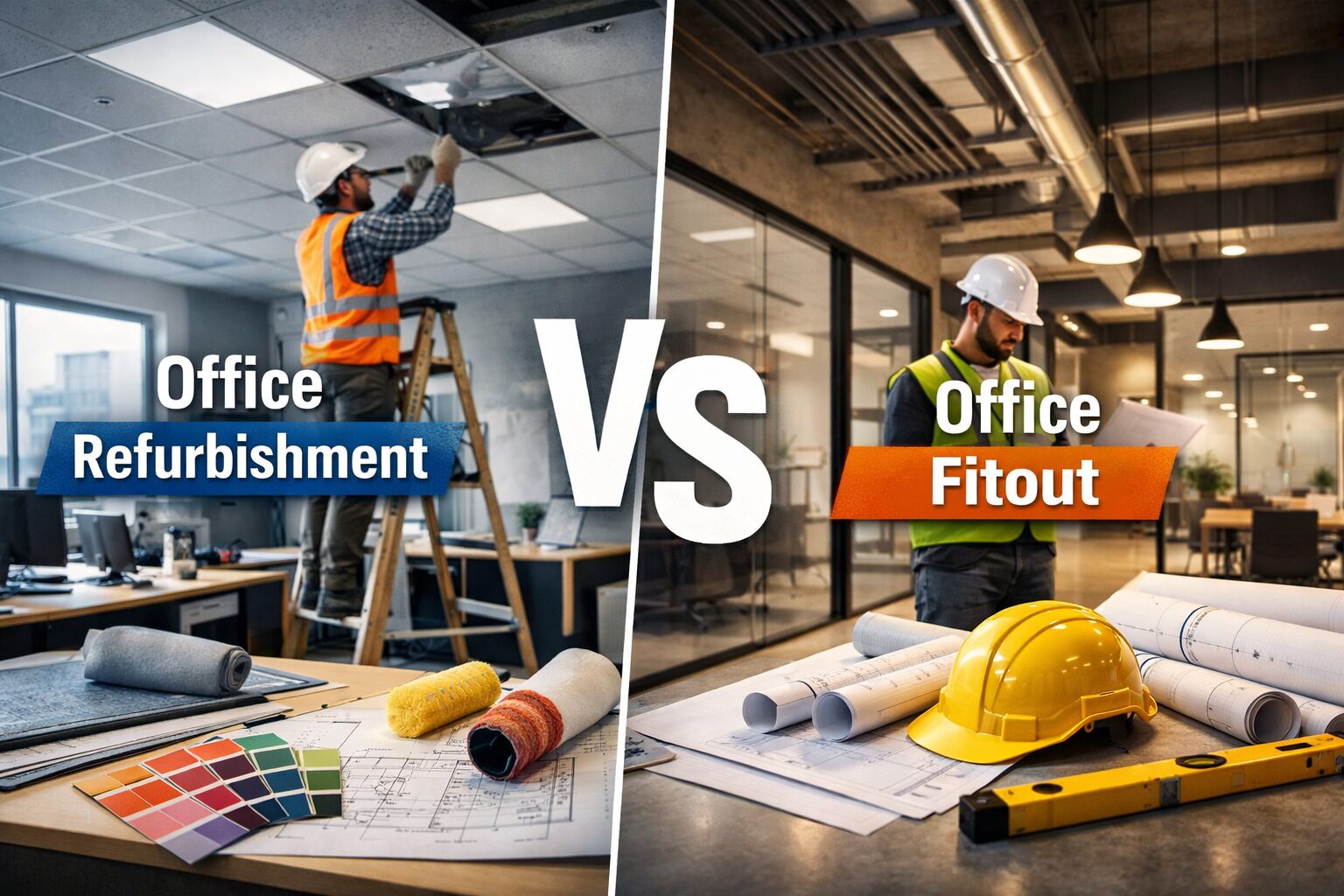
Understanding the distinction early can help you avoid unnecessary spend, compliance issues or a workspace that does not suit how your business actually operates.
In simple terms, an office refurbishment improves an existing workspace without changing its core layout, while an office fitout creates or fundamentally reconfigures a workplace to suit a specific tenant or business.
This guide explains the difference, when each option makes sense, and how to choose the right approach for your office.
What Is an Office Refurbishment?
An office refurbishment focuses on upgrading or modernising an existing workplace while retaining its underlying layout and function. The goal is to improve appearance, performance and amenity without rebuilding the space from scratch.Refurbishments are commonly undertaken to refresh dated interiors, improve staff experience, meet updated compliance requirements or extend the useful life of a building. Typical refurbishment works include new finishes, upgraded lighting, improved amenities, acoustic treatments, end-of-trip facilities and targeted services upgrades.
Many commercial refurbishments are delivered in live environments where the building remains operational. This requires careful staging, clear communication and experience working around tenants, building managers and access constraints.
O’Neill’s Design & Construction regularly delivers commercial building upgrades and refurbishments in operational buildings, managing disruption while maintaining safety and compliance. View our refurbishment capabilities.
What Is an Office Fitout?
An office fitout involves transforming an internal space so it functions as a workplace. This is most common when a tenant moves into a new tenancy, occupies a cold shell space or needs a complete reconfiguration of how their office works.Fitouts typically involve new partitions, meeting rooms, joinery, services coordination, data and power upgrades, compliance works and detailed integration with base building systems. Unlike refurbishments, fitouts are usually tailored specifically to how a business operates, including team structure, collaboration needs and future growth.
Office fitouts are often delivered under a Design and Construct model, where the contractor manages both design and construction. This approach provides earlier cost certainty, a faster program and a single point of accountability.
O’Neill’s Design & Construction specialises in commercial office fitouts delivered under Design and Construct and lump sum contracts. Check our Melbourne office fitout services.
The Key Differences Between Refurbishment and Fitout
The most important difference between an office refurbishment and an office fitout is intent. A refurbishment enhances what already exists, while a fitout creates or reshapes a workspace to suit a specific occupier.Refurbishments are generally lower cost and shorter in duration, particularly where services and layouts remain unchanged. Fitouts typically involve higher upfront investment but deliver a space designed specifically for your people, workflows and brand.
Another key difference is timing. Refurbishments are often driven by asset improvement, tenant retention or compliance upgrades. Fitouts are commonly linked to lease events, relocations, expansions or changes in how a business operates.
Understanding which category your project falls into helps prevent scope creep and ensures the right consultants, approvals and delivery model are engaged from the outset.
Which Option Is Right for Your Business?
If your existing office layout works well but feels tired, inefficient or outdated, a refurbishment is often the most practical solution. It allows you to modernise the space, improve amenity and uplift presentation without the cost and disruption of a full rebuild.If you are moving into a new tenancy, changing how teams work or requiring a space that better supports collaboration, privacy or technology, an office fitout is usually required.
Many projects sit somewhere between the two. In these cases, early contractor involvement is critical to define scope accurately, avoid unnecessary upgrades and ensure budget is spent where it delivers the most value.
Delivery Models: Design and Construct vs Lump Sum
Both refurbishments and fitouts can be delivered under different contract structures. Design and Construct is commonly used for office fitouts where early cost certainty and single-point responsibility are important. Lump sum contracts are more common where documentation is already complete, such as landlord-led refurbishments or base building upgrades.O’Neill’s Design & Construction operates as a Tier 3 head contractor, not a subcontractor. This means they take full responsibility for program, coordination, safety and quality across both delivery models.
Compliance, Safety and Live Environments
Compliance is often underestimated, particularly on refurbishment projects. Even relatively minor works can trigger requirements under the Building Code of Australia, fire services standards or accessibility regulations.Construction works in occupied buildings also carry additional obligations around safety, noise, access and communication. Safe Work Australia provides guidance on workplace health and safety responsibilities during construction and refurbishment projects, particularly in live environments.
Engaging a contractor experienced in live commercial environments helps manage these risks and prevents costly delays.
Speak With a Contractor Who Delivers Both
Working with a contractor who delivers both office refurbishments and fitouts allows you to receive advice based on what genuinely suits your situation, rather than a one-size-fits-all solution.If you are planning changes to your workplace and want early advice on scope, cost, disruption and delivery approach before engaging consultants, speak directly with O’Neill’s Design & Construction.
They work with tenants, building owners and asset managers across Melbourne and Brisbane to deliver practical, well-managed commercial projects.
Frequently Asked Questions
What is the main difference between an office refurbishment and a fitout?An office refurbishment improves an existing workspace without changing its core layout, while an office fitout creates or reconfigures a workplace to suit a specific tenant or business.
Which costs more, an office refurbishment or an office fitout?
Office fitouts typically cost more due to the extent of construction, services coordination and customisation involved. Refurbishments are generally lower cost but depend on scope.
Can a refurbishment be completed while the office remains occupied?
Yes. Many refurbishments are delivered in live environments using staged works, out-of-hours programs or split shifts.
Do office fitouts require approvals?
Some fitouts require building or authority approvals, particularly where fire services, accessibility or building classification are affected.
How long does an office refurbishment usually take?
Timeframes vary, but refurbishments are typically shorter than fitouts and can often be completed within weeks rather than months.
Is Design and Construct suitable for refurbishments?
Yes, particularly where early cost certainty or contractor-led coordination is beneficial.
What is a make good or defit project?
A make good or defit returns a tenancy to base building condition at the end of a lease. It is separate from refurbishments and fitouts but often overlaps in scope.
When should a builder be engaged in the process?
Early engagement helps define scope, manage compliance and avoid cost overruns, especially in live commercial buildings.
Who usually pays for refurbishments, landlords or tenants?
This depends on lease terms. Some refurbishments are landlord-led, while others are tenant-funded to improve amenity or branding.