

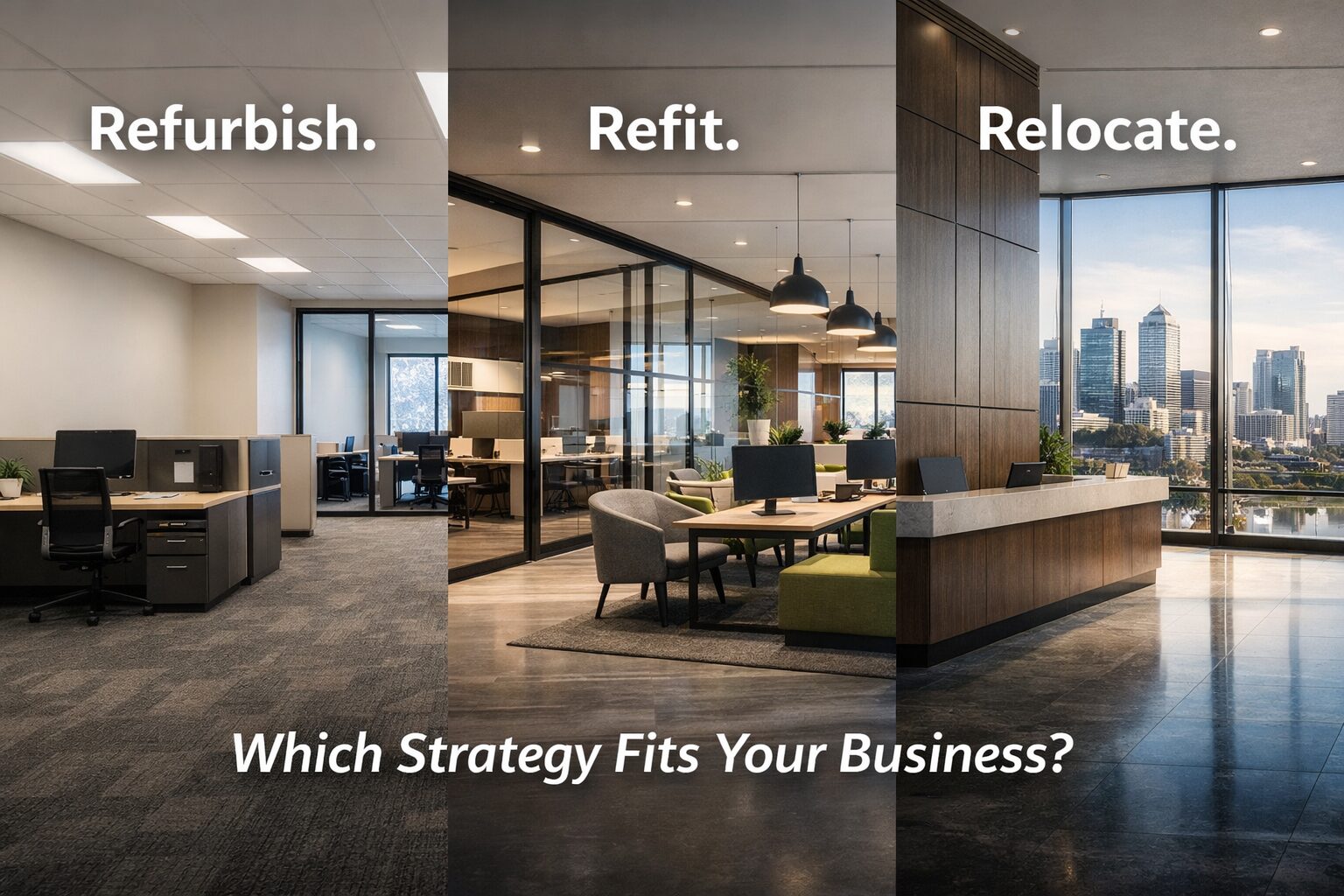
This is not just a property decision. It is a commercial decision that affects productivity, brand perception, staff retention and capital allocation for the next five to ten years.
For CEOs, leasing managers, asset owners and end users, the wrong move can lock in unnecessary cost. The right move can unlock performance and long term value.
This guide breaks down each option clearly so you can make a confident, commercially sound decision.
What Is the Difference Between Refurbishing, Refitting and Relocating?
Refurbishing an office means upgrading or modernising an existing space without fully redesigning it. This may include new finishes, lighting, services upgrades, lobby improvements or compliance works.Refitting an office means redesigning and rebuilding the internal layout to better support how your team works. This typically involves reconfiguring walls, meeting rooms, breakout areas, workstations and building services.
Relocating means moving to a new tenancy or building entirely. This includes lease negotiation, design, approvals and delivering a new workplace from base build.
If you want a deeper breakdown of terminology, see: Office Refurbishment vs Fitout: Key Differences
Option 1: Refurbish Your Existing Office
Office refurbishment is often the most cost effective strategy when the building itself is fundamentally sound.When refurbishment makes sense
Refurbishment is typically suitable when:- The building location still works
- The lease terms are favourable
- The structure and services are functional
- The space feels dated but not fundamentally flawed
If asset value uplift is your goal, review: Commercial Office Refurbishments That Increase Asset Value
Benefits of refurbishing
- Lower capital outlay than relocation
- Shorter programme duration
- Less disruption to staff
- Opportunity to stage works
Option 2: Undertake a Full Office Refit
An office refit is appropriate when your current layout no longer supports how your business operates.Hybrid work, team growth, changing collaboration styles and technology upgrades are common triggers.
When a refit is the right move
A refit makes sense when:- Headcount has changed significantly
- Space utilisation is inefficient
- Collaboration areas are inadequate
- Brand positioning needs strengthening
Understanding the budget is critical before committing. See: How Much Does An Office Fitout Cost In Melbourne? and Office Fitout Costs in Brisbane: 2026 Pricing Guide
Delivery model matters
For many end users, a Design & Construct model provides cost certainty and a single point of responsibility.If you are comparing procurement pathways, review: Design & Construct vs Traditional Tendering for Office Projects
A well structured refit can improve productivity, culture and staff retention without the disruption of relocation.
Option 3: Relocate to a New Tenancy
Relocation is the most transformative option. It is also the most complex.When relocation is justified
Relocation should be considered when:- Lease renewal terms are unfavourable
- The building cannot support growth
- Location impacts recruitment or client access
- Expansion within the current building is impossible
The hidden costs of relocation
Relocation typically includes:- New fitout costs
- Make good obligations
- Potential double rent
- Furniture and IT relocation
- Staff disruption
- Programme risk
Early Contractor Involvement can significantly reduce programme and cost risk.
Relocation can deliver strong brand repositioning. It must be commercially justified.
Cost Comparison: Refurbish vs Refit vs Relocate
Below is a simplified comparison framework.| Strategy | Capital Cost | Timeline | Risk Level | Best For |
| Refurbish | Low–Medium | Short | Low | Asset refresh, lease renewal |
| Refit | Medium | Medium | Moderate | Growing teams, hybrid shift |
| Relocate | High | Long | Higher | Strategic repositioning |
- Refurbishment generally requires the least capital.
- Refits require more design and services coordination.
- Relocation involves the most variables and financial exposure.
Timeline Considerations
Programme timing is often the deciding factor.Refurbishment programmes are typically the shortest, particularly if works can be staged or undertaken after hours.
Refits require design development, authority approvals and services coordination. For a clear breakdown, see: Office Fitout Timeline From Feasibility to Handover
Relocation adds lease negotiation and due diligence to the programme.
Underestimating timeline risk is one of the most common commercial mistakes.
ROI and Strategic Impact
From an ROI perspective:Refurbishment improves presentation and can enhance leasing appeal for building owners.
Refits improve workplace performance, collaboration and employee experience. Research from the World Green Building Council demonstrates that well designed workplaces positively impact productivity and wellbeing.
Relocation offers the strongest brand repositioning opportunity but requires disciplined financial modelling.
The correct decision balances short term cost against long term strategic benefit.
Frequently Asked Questions
Is it cheaper to refurbish or relocate an office?Refurbishment is almost always cheaper upfront. Relocation includes new fitout costs, make good and relocation expenses.
How long does an office refit take?
Most medium sized office fitouts take 8 to 16 weeks from finalised design to handover, depending on scope and approvals.
Can we stay in the office during refurbishment?
Often yes. Staged works and after hours construction can minimise disruption.
When should we relocate instead of upgrading?
Relocation is justified when location, growth constraints or lease conditions create long term strategic limitations.
Does refurbishment increase property value?
For building owners, targeted lobby and amenities upgrades can significantly improve asset value and leasing outcomes.
What is the biggest risk in relocating?
Programme delays and budget overruns caused by incomplete feasibility or services coordination are common risks.
Should we use Design & Construct for a refit?
Design & Construct provides a single point of responsibility and early cost control, which many end users prefer.
How do we benchmark office fitout costs in Brisbane?
Use current market pricing guides and obtain feasibility budgets before committing to lease terms.
What if we must return the tenancy to base build?
End of lease obligations may require de fit works. Plan these early to avoid penalties and delays.
How to Decide
The right strategy depends on five key factors:- Lease position
- Building condition
- Business growth trajectory
- Capital availability
- Programme timing
If your business model or workforce strategy has fundamentally changed, relocation may be the smarter long term investment.
The critical step is early commercial modelling and feasibility.
Before You Commit to a Lease or Move
Before renewing a lease or signing a new one, speak to a contractor who understands both delivery and commercial risk.O’Neill’s Design & Construction delivers office fitouts, refurbishments and workplace projects across Melbourne and Brisbane under both Design & Construct and lump sum models.
You can explore recent commercial projects.
Or speak directly with the team to assess feasibility, cost and programme risk.
A structured feasibility discussion today can prevent a costly strategic mistake tomorrow.
Choosing whether to refurbish, refit or relocate is not simply about space. It is about positioning your business for the next phase of growth.